Originally published on March 29, 2026 on my starter blog for a class assignment.
“Writing isn’t playdough. It is not meant to be endlessly shaped to please everyone, which means deciphering our audience and writing for people who appreciate our perspectives and engage with our writing.” — Ranjana Srivastava
In age of #BookTok making books about satisfying readers’ desire to see certain tropes rather than allow readers to follow along a carefully crafted journey from start to finish, it seems writing, more than ever, is pivoting away from authorship and instead to every whim and want of the faceless “reader.” Within the romance genre in the past few years, terms like “enemies-to-lovers” and “fake dating” have grown to be normal descriptors of novels. Book influencers will rave on social media about their top five favorite books featuring “forced proximity” while scant or entirely absent of any actual plot descriptors that we would traditionally expect to function as a book’s means of enticing potential readers.
Beyond such horrific marketing tactics leading to a phenomenon dubbed the “tropification” of books, it seems now so many novels (and films, TV shows, etc.) come automatically with eight dozen articles and YouTube videos titled “Breaking down the meaning of [Book name]” “What actually happened in [Book name]?” “What was [Book author] really trying to say?”. While I think discussion on interpretations of meaning are valuable to have in discussion-based spaces, when we turn the interpretation of literature into quickly-consumable pop culture features, what are we doing to the labor of critique? Is the general reader going to bother to sit with the confusion or questions a book gives them, or are they going to quickly open Google and type “[Book name] explanation”?
One of the realities of publishing is the review and editing process. Recently, my favorite short story I’ve ever written (in a fugue state on my best friend’s back porch two winters ago while dog sitting for her parents) was selected for publication in a literary magazine. It is largely allegorical and its isolationist themes and mystery are influenced heavily by my favorite book of all time Moi qui n’ai pas connu les hommes by Jacqueline Harpman. In the same way that book scratched at my soul and concluded without satisfaction or resolution of the novel’s unknowns, my goal with my story was to present events and feelings as they are, even if unexplainable in origin, and try to end on the same hollow and hopeless note as Harpman’s writing. In essence, the extent of my relationship with readers was to pull a feeling out of them — not to provide explanation for why anything in the story was happening.
When I received back comments for revision, some of the notes conjured thoughts of this appeal to readers and their supposed need for explanation or ease when reading. In a scene where the narrator is being pulled into a pitch-black forest by frightening thirty-foot tall creatures with a leash, several of the editor’s notes were about breaking up long sentences or breaking up long paragraphs to build a sense of immediacy and avoid fatiguing readers. Without the ability to sit down with the editor and talk through my choices, what they see as an impeding function is actually the intended purpose. The long sentences and long paragraphs in this scene are to create the feeling of being pulled down, just as the narrator is, and build a sense of claustrophobia and dread. But, of course, silly me — I would not want my poor reader’s eyes to get tired as they read this scene. I will certainly chop up my sentences and paragraphs here with not an ounce of insult to the intelligence of my audience. That seems like the right thing to do.
My sarcasm here is only an expression of my frustration with many of the current methods we have with editing and review. A document or draft viewed in isolation between submission pages and email chains fractures the writing process by removing personhood from both the author and the editor. Of course an editor cannot understand everything going on in my brain behind a piece, and, in turn, it can be easy to grow frustrated with someone who I cannot otherwise talk to as they read my work. It’s this revision format that is so common in the world of magazines and short-form publications that is so fundamentally flawed, and, in cases of more rigid publications, can remove author voice entirely, or make choices aimed at appealing to the presumed limited imaginations and short attention spans of modern readers (at what point will this trend end? When videos are three-seconds long and the standard format for a paragraph is a single sentence?).
It was in my Writing Workshop Methodologies class as a college junior where I first engaged in face-to-face review. Previously, all of my experiences had been in a turn-and-exchange-papers format or where the instructor scans over a draft. Not many of these experiences I would label as positive. The common problems I would run into were the threat of my seeming too harsh when I’d hand back papers stained in red or that my peers or teachers would have nothing constructive to say to me and I’d walk away having nothing to learn from the experience
However, on our first peer workshop day in Writing Workshop Methodologies, my professor, the English Department legend Dr. Kates, had us print out multiple copies of our work for others to read as we were made to read aloud our essays in small groups. We weren’t left to our own devices with commentary, but were asked to follow a particular model to help shape constructive feedback. The goal was that we didn’t become, as Kates dubbed it, “mutual admiration societies”, but also that we weren’t totally shredding each other’s personal writing. The model was the ladder of feedback, a framework developed by Daniel Wilson.
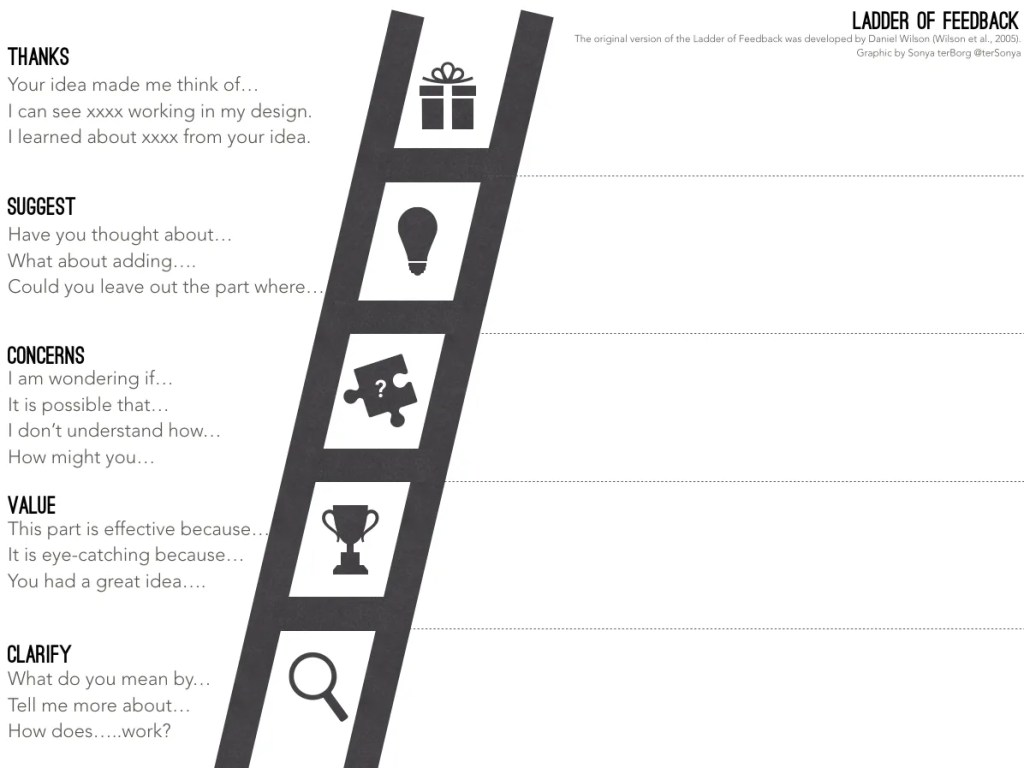
The majority of the ladder of feedback’s sentence stems are questions, rather than comments. This is the very core of the ladder’s efficiency in the review process. A comment starts and ends, but a question invites a conversation. The feedback ladder makes the process about understanding and learning from both author and reviewer. Rather than blindly allow reviewers to read a piece, I could explain certain sections and pose questions of my own. “I was trying to do [xyz]. Can you tell me if that resonates with you as a reader or if I have some gaps I still need to fill to achieve that effect?”
This centering of the self in the most fundamental part of the writing process — review — has such an understated importance. When reviewing becomes faceless and devoid of human connection, writing can then be treated as playdough to mold to the touch of every reader rather than a piece a writer is trying to mold for themselves. Yes, I want my stories to resonate with readers, but before all else, I want them to resonate with me. I want them to be for me. I want them to satisfy myself above all else, and maybe readers will be lucky if they are, too, satisfied with it. There are parts of my writing — pieces of myself — that I fundamentally cannot change no matter the thoughts of others who do not possess the same brain as I do. Who have not lived my life and don’t need to say the same things I need to say.
What do I care for a reader’s confusion or understanding when I write the most articulate and moving piece I’ve ever written about grief as a choose-your-own-adventure story? Why should I need to change intentionally incorrect grammar or punctuation or a word that doesn’t exist because you view it as a red underline to eliminate rather than a stylistic choice? My writing is for me, myself, and I always and always and always (and would you look at that? Polysyndeton. A stylistic choice. Should I have instead used commas? This one’s for you, Dr. Pantelides!).
To any writer who is finding too much of their writing process is focused on what others want or think, screw that. You have poured too much of yourself into your craft and your heart into the stories you tell to make it about anyone other than you. The next time you find your work turning into moldable playdough at the hands of others, snatch it back, form it into a ball, leave it out to harden, and then throw it in the face of anyone who makes your writing about themselves and not the actualization of who you are as a person who is foremost and fundamentally and always and forever, a writer.
— S.L.
 S.L. Kletz
Leave a comment