Originally published February 15th, 2026 on my starter blog for a class assignment. Edited June 16th, 2026.
When reflecting on Michael Warner’s Publics and Counterpublics and searching the corners of my mind for examples of what may constitute as a text representative of a counterpublic, the revolutionary anthem “Fuck tha Police” came straight to my mind.
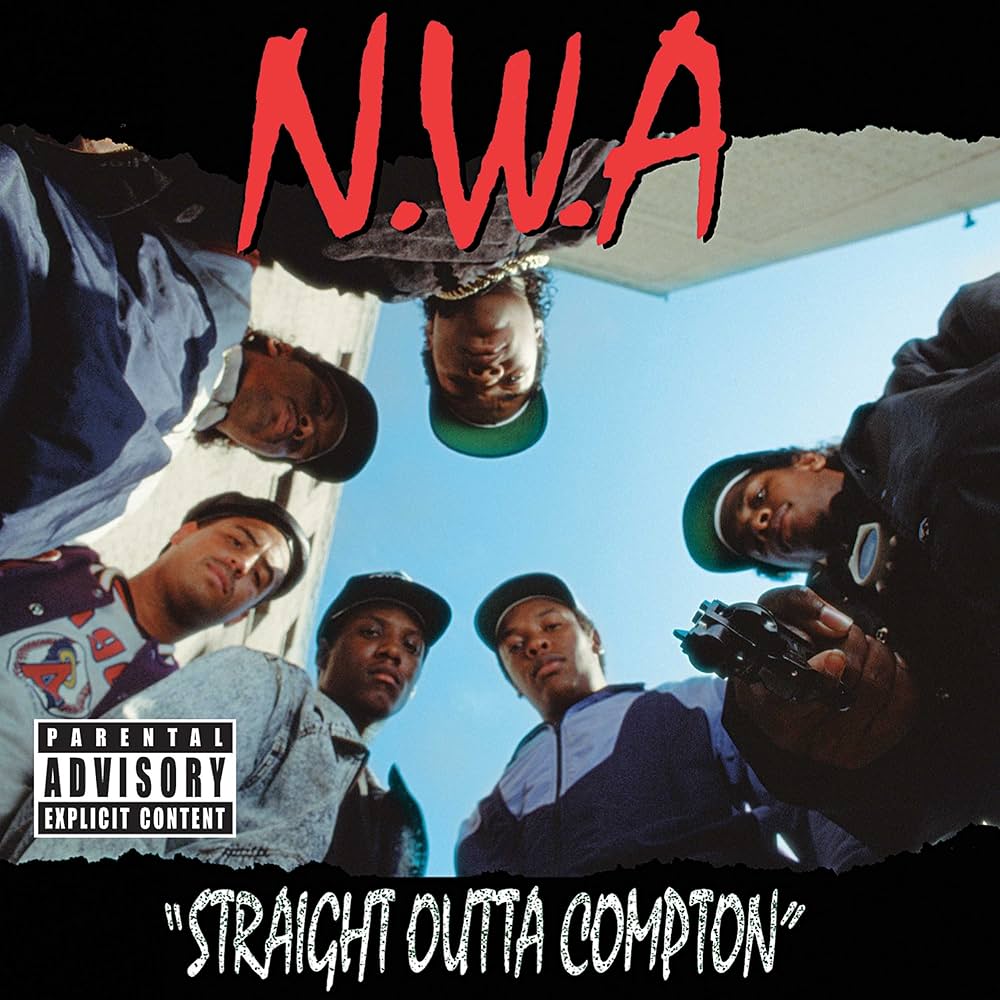
Featured on N.W.A’s 1988 album Straight Outta Compton — the first album cover to ever feature a parental advisory label — “Fuck tha Police” sets up a fictional courtroom where MC Ren, Ice Cube, and Eazy-E act as prosecutors against the LAPD in a trial overseen by Dr. Dre as the judge. On the stand, each member addresses the jury with a commentary on the corruption and racism rampant within the LAPD, as well as assertions of their defiance against this authority.
The song comes as a response to the socioeconomic difficulties and police corruption rampant in L.A. in the 1980s. The outsourcing of jobs left almost half of African-American men in the area unemployed, while the expansion of the U.S. prison industry was beginning to make itself apparent, with an 115% increase of prisoners between 1980 and 1989, according to the Bureau of Justice Statistics. Operation Hammer, an LAPD initiative to combat gang violence, arrested over 50,000 people in the span of three years in the late 1980s and coincided with cases of police brutality, including a 1988 apartment raid that caused so much damage that the Red Cross needed to provide aid to those left homeless by the event. As citizen complaints of police brutality in the area rose, only a handful of the police officers investigated for the use of excessive force between 1986 and 1990 were ever prosecuted.
It remains then, ever apt that the lyrical world of “Fuck tha Police” takes place in a fictional courtroom, where injustices are brought to light and the LAPD is held accountable for their treatment of Black residents in South Central LA, where the city of Compton is located. “Our people have been wanting to say, ‘Fuck the police’ for the longest time,” Ice Cube shared after the song’s release.
The lyrics grapple with a lot of moving parts at once, yet still remain cohesive to a larger story of police brutality — both in its lived experience and emotional response to it. Ice Cube comments on specific issues he observes in the LAPD, notably Black officers using excessive force contrary to the desired expectation of solidarity in a shared minority identity — “But don’t let it be a black and a white one / ‘Cause they’ll slam ya down to the street top / Black police showing out for the white cop.”
Beyond the song’s expression of frustrations the predominantly Black South Central LA community held with the LAPD, the lyrics take on a tone of heroic defiance — a notable invincibility in the face of the threat of police brutality. MC Ren describes this resilience in his narrative about being pulled over — “…they mace me to blind me / But that shit don’t work, I just laugh / Because it gives them a hint not to step in my path.” Following this, he turns common police phrasing against them and offers up a challenge for an equal fight devoid of the cop’s weapon.
What is so revolutionary in the song’s challenge to authority is the direct language it uses to demonstrate the racist violence of the LAPD being amplified by their authority and issued weapons (“Without a gun and badge, what do ya got?”), and the response of violence in return (“A sucker in a uniform waiting to get shot”). What truly steps on the toes of the wider public is not as much the lyrics’ honest exposure of police brutality, but the idea of that brutality being returned. The song uses the mode of revenge fantasy to flip the power dynamics and place the fear that many people have of the police back onto the institutions of power that enable and execute corruption and brutality.
The backlash to this song by Evangelical groups and authorities were considerable, even prompting the Assistant Director of the FBI to send a letter to N.W.A’s label, stating the song “encourages violence against and disrespect for the law enforcement officer” and that the song is “discouraging and degrading to these brave, dedicated officers.”

Despite the backlash by various groups, the undeniable cultural impact of “Fuck the Police” upon social and civil movements demonstrates the power of this song as it continues to echo and resonate in waves alongside cases of police brutality far past the Los Angeles area and the late ’80s themselves. After the murder of George Floyd by police officer Derek Chauvin in Minneapolis in 2020, N.W.A’s hit saw a 300% uptick in streams alongside other protest anthems.

With the world’s eyes currently on I.C.E. operations — especially in Minneapolis earlier this year, where people lived for months in fear of raids, violence, and racial profiling by thousands of federal officers aiming to deport residents in Operation Metro Surge, “Fuck tha Police” resonated once again in its near forty-year history. In the month of January 2026 alone, eight people died in I.C.E.-related incidents, including two U.S. citizens shot by officers in Minneapolis. N.W.A.’s reach has been steadily growing since early 2025 and had a significant jump on Spotify in February, according to Songstats data. On the YouTube video for this song, new comments read, “We all know why we’re back to this song” and “This song goes out to ICE” intermixed with comments posted nearly six years ago reading “RIP George Floyd. Can’t wait for the day this song is outdated” and “‘They’ll slam you down to the street tops’ Rest In Peace George.”
“Fuck tha Police” may very well then be the most impactful and relevant counterpublic text ever made, taking a resonant topic amongst the Black population of Compton and the South Central Los Angeles area and circulating it into spaces beyond the historical situation that created it, both prompting backlash and finding home in the genre of protest anthems that still remain loud and ever present to this day.
 S.L. Kletz
Leave a comment