On Sir Arthur Conan Doyle’s exploitation of women’s oppression and the problematic happily-ever-after ending.
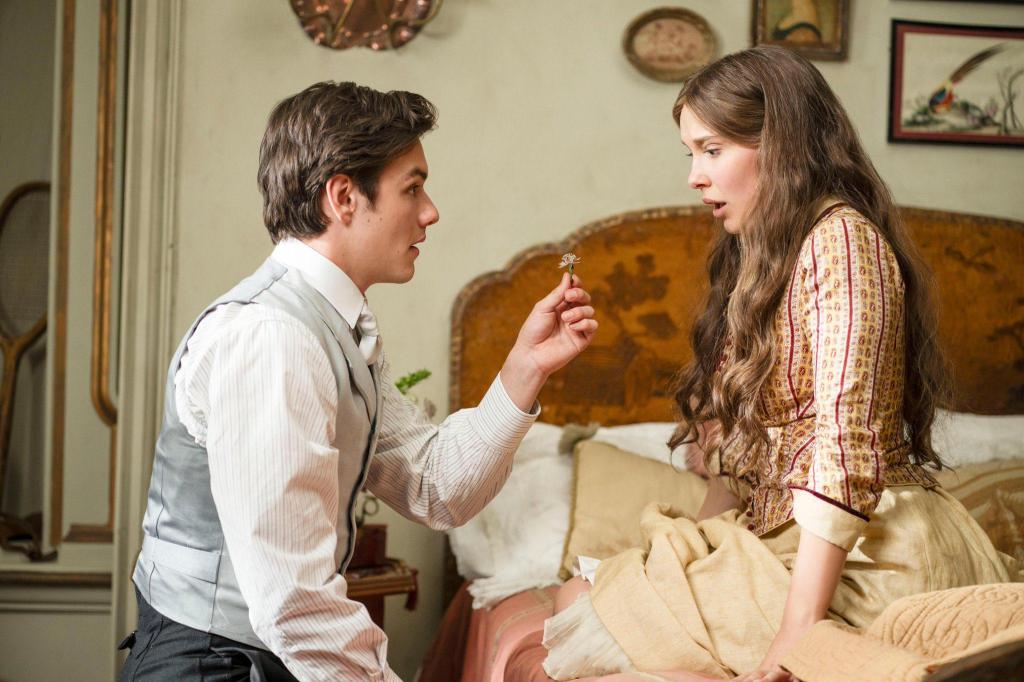
We are a little over a week into Enola Holmes 3‘s release on Netflix, and regardless of critiques of Millie Bobby Brown’s press-on nails and full beats on set, I have always thoroughly enjoyed the Enola Holmes film franchise. Though it does spend time with real issues that occurred during the Victorian era, like the Matchstick Girls and the Anglo-Afghan War, it’s not a series that promises realism — in fact, the very opposite: Brown’s titular character breaks the fourth wall continuously throughout the films to make funny quips or explain her thinking — a staple essential to what makes Enola so quirky and lovable. It’s not a story that needs to be real — even its original source is only loosely tied to the Holmes canon.
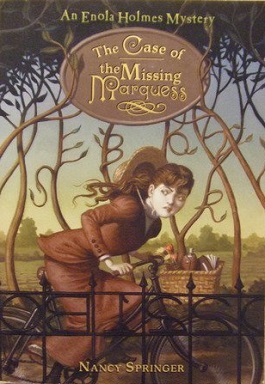
The Netflix franchise is based off an adolescent book series The Enola Holmes Mysteries from author Nancy Springer (if you’re a 2000s baby like me, you might have vague memories of this cover featured somewhere in your elementary school library). Springer published six books featuring Enola between 2006 and 2010, and renewed the series after the success of the 2020 Netflix adaptation.
The first film takes after the series’ first novel Enola Holmes and the Case of the Missing Marquess, but that is the only film in the franchise that is specifically adapted from the content of a book in the series. Aside from Enola defying Victorian expectations of women at the time — practicing her independence and opting for practical clothing and disguises over corsets — the book series occasionally deals with women’s issues during the era. In the series, Enola helps Lady Cecily Alistair escape a forced marriage and uncovers Crimean War-era espionage credited to Florence Nightingale. It certainly is not as punchy in the girl power tone as the films are, but also stands on its own from the Sherlock Holmes‘ canon, electing to borrow some of Sir Arthur Conan Doyle’s original characters like Dr. Watson.
A notable distinction between the film franchise and the books series, is that Lord Tewkesbury (Tewksbury — no e — in the books) is not a romantic feature of the books. In fact, he is actually younger than 14-year-old Enola in The Case of the Missing Marquess. This is the only novel of the original series he is featured in, and his character only returns for one of the newer novels published post-film-adaptation to assist Enola on a case on a purely platonic, thanks-for-helping-me-out-that-one-time level.
I am uncertain if the writers for the films went into the development of the original adaptation with possible plans for a franchise contingent on the success of the first film, and whether, if this was the case, Tewkesbury was going to stay on as a character. Regardless, fan response (aka an abundance of TikTok thirst edits of *cough cough* a minor) to Louis Partridge’s performance pretty much guaranteed him a recurring role in the franchise, this time around as a love interest for a romantic subplot. Because one thing Netflix for sure loves to do is make Millie Bobby Brown smooch floppy-haired boys while she’s still herself a child (can we acknowledge now, a decade later, that Stranger Things was weird as fuck for making twelve-year-olds kiss on camera?)
Now, with Enola Holmes 3 raking in millions of views, there is a present uncertainty about the franchise’s future (Enola and Tewkesbury with a set of crime-fighting toddlers? Netflix, I am awaiting your call). The present trilogy, narratively-speaking, caps off nicely with a wedding, and could satisfactorily sit at a conclusion where it currently stands.
However, though, there is an irony in Enola’s very own proclamation that all great stories end with a wedding — satisfying the fairytale trope of marriage coinciding with a “happily ever after” for the characters and subtly reinforcing marriage as the ultimate goal for young girls and that nothing interesting or important happens after I do. For all of the series’ feminism, I was a little disappointed it chose to conclude itself this way.
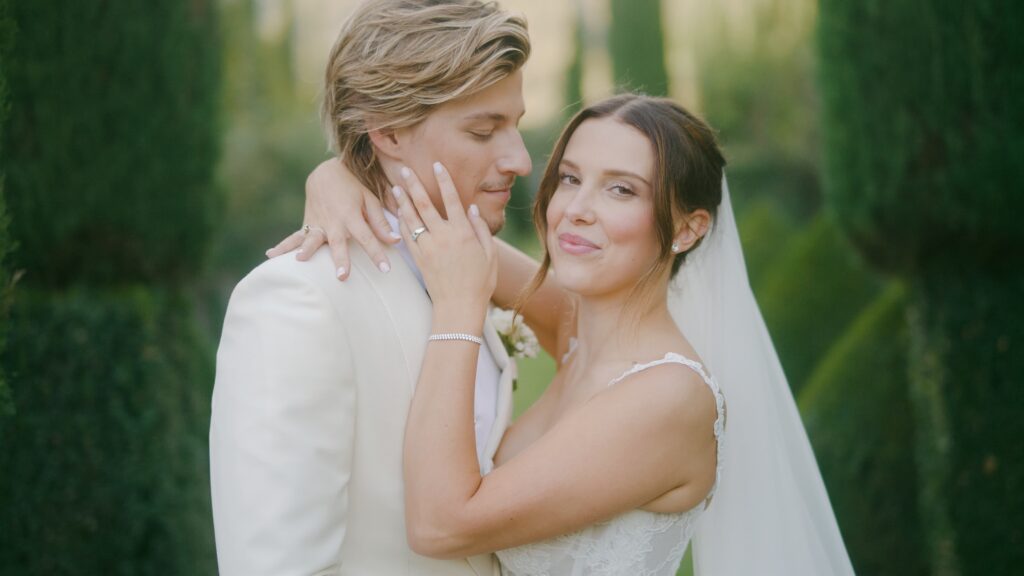
After learning Millie Bobby Brown’s involvement in the script development for the film, everything about this movie started to make more sense. Filming for the movie began just a year after Brown wed Jake Bongiovi in May 2024 after Bongiovi had proposed to her underwater while scuba diving the year prior. The pair held a destination wedding in Italy a few months after they legally married, and Millie changed her last name to Bongiovi, although keeping Millie Bobby Brown professionally. Hmm… Do these things remind you of anything? Perhaps a destination wedding in Malta… Contemplations of losing the Holmes’ name as a budding investigative professional… Multiple swimming scenes throughout the film. What really sold it for me was learning that the intimate scene in the film where Tewkesbury braids Enola’s hair in their Victorian undergarments was inspired by the fact that Brown’s own husband braids her hair before bed every night. Oh, and that Brown tried to make her wedding dress in the film look similar to her real-life wedding dress because surely 21st century attire will make a lot of sense in a 19th century film (okay, maybe I can’t be snide here because I did profess earlier I don’t really care about the accuracy of period dress when all of the characters are fictional).
What matters though is that this franchise is much too delightful and smart to let what could be its final film be a self-insert for Brown to turn Enola Holmes into a memory box for her own marriage. I am not lopping blame onto Brown — the woman has been through enough of that already. The executives who knew public interest in her private romance would influence film viewership are the ones to blame for how off Enola Holmes 3 felt compared to the rest of the franchise.
As one dives further into the canonical history of Sherlock Holmes and recognizes the deeply embedded allonormativity in media, a single question arises above any speculation about Brown’s involvement in the wedding plot in the script: did anyone ever ask themselves if Enola Holmes really needed to get married at all?
While certainly not tied to its own canon, Enola Holmes 3 bears echoes of the wedding bells featured in The Adventures of Sherlock Holmes, wherein Sir Arthur Conan Doyle repeatedly uses women’s oppression and marriage as a plot device to amplify audience attitudes towards Sherlock’s brilliance rather than critically evaluate why marriage has a pattern of harming women (and I wonder which character loves to identify patterns?).
In The Adventures of Sherlock Holmes‘ “The Noble Bachelor,” Lord St. Simon, a noble whose wealth is dwindling considerably, marries the immensely wealthy and widowed Hatty Doran despite having no previous interest in love in order to obtain the riches of her dowry. In describing Doran to Sherlock Holmes, St. Simon details her wild and tomboyish disposition which strongly contradicted expectations for Victorian women — similarly to Enola — and he assures he, “would not have given her the name which [he has] the honour to bear… had not [he] thought her at bottom to be a noble woman” and goes on to remark her capability of sacrificing her free spirit and autonomy upon joining the royal family. This is clearly an unequal exchange between the two — he receives a dowry of millions while she is expected to surrender her wild spirit in adoption of nobility in marriage to a man motivated by class preservation rather than love. When Doran runs away after their wedding after recognizing her late husband — alive and well — in the chapel, St. Simon declares she has used him (uh, buddy… look in the mirror) and fears disgrace from his family.
In an instance featured in “A Case of Identity,” Sherlock solves the mystery of the near-sighted Mary Sutherland’s missing fiancé — deducing her fiancé did not exist at all, and was merely her own stepfather impersonating a man to dissuade Sutherland from marrying anyone else so he did not have to relenquish the income he made off of her deceased father when she was to wed.
In Victorian England, marriage acted as a transfer of a woman and her finances between men — creating a loss of money on her father’s behalf and a gain on her husband’s — an obvious fact to Sherlock who reasons he knew her step-father was impersonating her fiancé because he was, “the only man who really profited by [the fiancé’s disappearance].”
This is not the only time in the book that a father intervenes in his daughter’s nuptials due to fear of losing his money and class status. In “The Speckled Band,” Helen Stoner comes to Sherlock Holmes fearing for her life leading up to her wedding, as her sister Julia had mysteriously died before her wedding just a few years prior. Both sisters had grown up being abused by their step-father Dr. Roylott — the remaining survivor of an old, high-class family dwindled to financial ruin who faces the loss of Helen and Julia’s late mother’s money once they are wed. Within this situation, marriage is unfortunately one of very few options (maybe the only one?) for the sisters to escape the abuse of Dr. Roylott, who — shocker, shocker — turns out to be the murderer. Once Helen is free of Dr. Roylott, she remains characterized in the story as helpless — merely an opportunity for Holmes to save a “poor girl” — falling back upon a damsel in distress trope that exists only for Holmes to employ his intellect and enthrall readers with a satisfying mystery without pondering: hey, it’s kind of really shitty that women are trapped between their fathers and husbands and maybe women should be able to safely get themselves out of bad situations without a man involved.
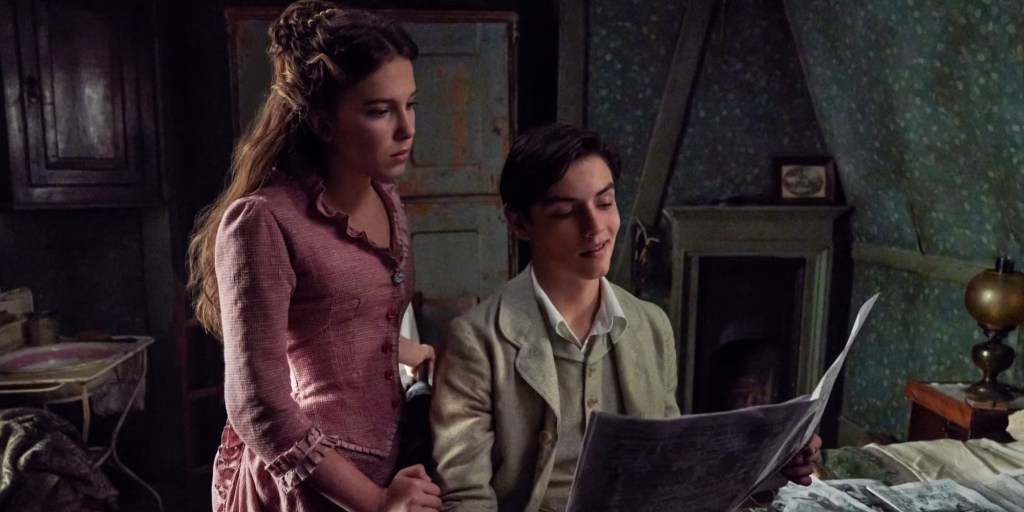
While, of course, the marital circumstances of Enola Holmes 3 are a far cry from the deep-set, uncriticized oppression of marriage in The Adventures of Sherlock Holmes, the film recognizes that marriage is historically oppressive for women. Though it remains very clear Enola and Tewkesbury’s relationship is much more progressive and balanced, the only question the film seems to ask about marriage is how it factors into the erasure of female identity. And somehow it takes nearly two hours for a literal detective to conclude that her identity is what she makes of it, and she doesn’t have to change who she is to be a wife (yes, I know that is obvious to a modern audience and perhaps not a Victorian character, but Enola is far more self-aware and progressive than all of her character’s manufactured, shallow fretting about her Malta wedding to Lord Tewkesbury in the beginning of the film).
In the wake of the popularity of the wedding horror genre — with films like Ready or Not and shows like Something Very Bad is Going to Happen exploring the suffocation of crazy in-laws and, even worse, fiancés and husbands who take their sides — I think Enola Holmes 3 is very in line with progressive thinking to say women can take their own paths. Sometimes that includes marriage. Sometimes that includes lots of blood and carnage and the final girl driving away from the scene of the crime while some 60s doo-wop song sings her out into the credit roll.
However, when the acceptance of marriage as an institution Enola can be herself within is accompanied by quips of “You may now kiss the husband” the girl power feminism the franchise has otherwise been quite successful at feels hollow and Tik-Tok-ified, catering to young girls eating up fantasies of a Louis Partridge romance (maybe listening to some Olivia Rodrigo here too, hmm?). It is even more shallow when we know that Tewkesbury was only a single-novel feature of the original series and was portrayed as a nervous kid accepting the help of an older Enola Holmes and carrying on his merry way at the conclusion of the book. So when the film adaptation gets renewed for a second movie, for some reason it is absolutely necessary to throw a romantic subplot in there, because what else keeps viewers coming back to a series aside from the promise of kisses in carriages? (I will give them credit: Enola and Tewkesbury’s wholesome carriage scene happened to be way more tantalizing than Bridgerton‘s Colin and Penelope’s R-rated carriage scene people waited 3 whole seasons for).
Again, I am uncertain if Lord Tewkesbury was intended to stay on as a character because I am uncertain if writers were originally planning for Enola Holmes to go beyond a single film. Sure, it makes fiscal sense when you see the internet’s reaction to the sensitive and handsome Lord Tewkesbury of the first film to stuff him into the next one (I imagine someone important in charge of the second film’s budget, donning douchey sunglasses, exclaiming — “The numbers on this skinny white boy are through the roof! Get him another contract stat!”). While I can accept this move as effective (again, fiscally), the tonal shift of the films between Enola Holmes 2 and 3 is a little jarring. Enola goes from uncovering labor abuses faced by female factory workers to her nemesis intercepting her extravagant destination wedding for *checks notes* blood money stolen by her fiancé’s war criminal father (the skinny white boy spends a lot of time grieving that his father isn’t a hero and I really could not muster the ability to feel bad for him. Whoops.)
Is Enola Holmes 3 really then flipping the marriage-isn’t-feminist narrative on its head by acknowledging that love and female agency can coexist? Or is the film’s marriage just a prop for a romantic subplot that has somehow become the main plot of a story meant to be about a girl who solves mysteries? Can we imagine an Enola Holmes where Tewkesbury was a character she happened to save in one movie and that’s it? Or, if we must tack on recurring characters, can we conceive of a story where he is a friend rather than a lover?
Is popular media ready to dare to let women be on their own? And not after blood and carnage and doo-wop music — to truly be on their own? While driven male characters can often be portrayed as excusingly aromantic — including Enola’s very own brother — women are not often afforded that same luxury. Even if a woman is busy kicking ass and saving the world, God forbid she doesn’t have someone on the sidelines of the plot to soften her (which makes her complex! Yay! We score feminist character points!). Surely women aren’t capable of being soft without a romantic partner or children. Surely we can’t think of anything else to make a film interesting aside from the looming potential of a kiss at the end.
I am not plotting on a franchise downfall or poor ratings for Enola Holmes 3, and I would certainly be eager to watch Enola Holmes 4 if it ever came to be (again, Netflix, CRIME-FIGHTING TODDLERS). However, with a media industry oversaturated with surface-level feminism, Enola Holmes, to me, had been an enjoyable stand-out in a girl power genre I don’t typically enjoy (for all of the surface-level feminism). Millie Bobby Brown’s authenticity to Enola’s eccentricity and big personality are what made the franchise so endearing and fun, and are what were key to making quirkiness work in Enola’s favor rather than against her (hello Señorita Awesome). But there was something that had been there — even among the romantic subplot of Enola Holmes 2 — that was lost in Enola Holmes 3 as independent Enola turns into a nervous bride contemplating loss of identity as if she hadn’t already faced the battle of living in her brother’s shadow in previous films. That a smart-as-a-tack mystery solver couldn’t arrive at her own conclusion that her marriage was what her and her husband would make of it without running around Malta digging up war crimes and pirate treasure for an hour-and-forty-five minutes.
The anxieties of marriage are valid ones to showcase in the film, but Enola’s marriage to Tewkesbury feels like the product of a script clawing at romantic substance by tacking itself onto the happily-ever-after fairytale trope party and infusing itself with fodder from a real-life marriage without any critical evaluation of why that made sense for the film aside from Netflix promised Brown producer credits and the old-reliable money maker of young-girls-fall-hard-for-skinny-white-boys (some bonus points here, too, because this one’s British).
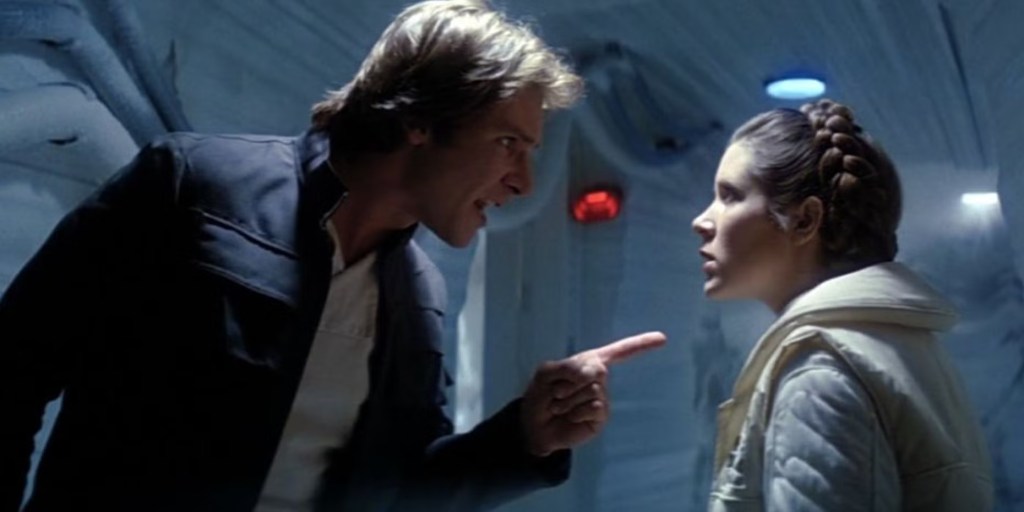
Women in media deserve to get to do cool shit like solve mysteries without romance involved — that goes for both queer and hetero relationships. Production and publishing industries need to start platforming stories where women get to be main characters on their own, rather than hoping to garner audiences on the contingency of romance sprinkled into a larger story. We need Trises with no Fours. Hermiones with Ron just as a friend. Leias that shoot Han Solos in the skull the moment he crosses a boundary after she tells him no (okay, that’s just me being a little indulgent here).
Interpersonal relationships can be part of what bring fullness to our lives, but narratives that suggest personal fulfillment is contingent entirely on others is bullshit, and ones that suggest personal fulfillment is contingent entirely upon romance is just utter propaganda. A long table full of friends seems appropriate for someone with a personality like Enola’s, but — for all the trouble the series goes to to express that her name does not fit her — would it be best if Ms. “Alone”-backwards really did end up alone?
 S.L. Kletz
Leave a comment