From Charlie Kirk to now Lindsey Graham, why do people keep eulogizing racists?
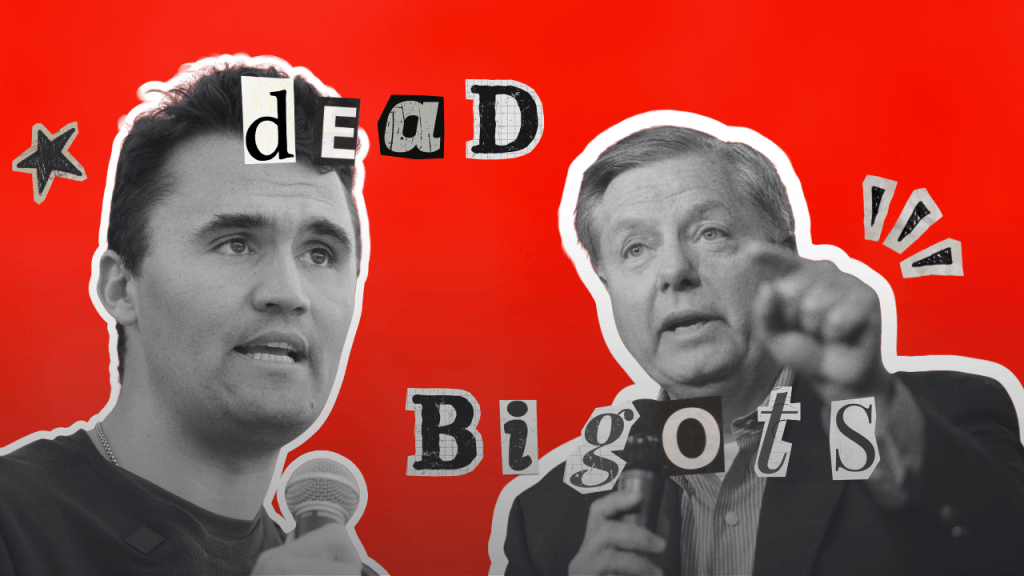
When I woke up to the headline Senator Lindsey Graham had died at age 71, for a second I thought it was talking about Mitch McConnell kicking the bucket, but then reality hit me. This is Congress we’re talking about. The Grim Reaper practically sits in the rostrum of the U.S. Congressional Chamber next to the Speaker of the House, sharpening his scythe while we await legislation on congressional term limits (and the next representative to keel over dead on the floor). McConnell is only so far behind Graham (or maybe ahead, according to internet conspiracies).
Sen. Graham was just one of many legacy politicians who elected to choose power over retirement, and is no different than men like Donald Trump and Joe Biden who both need to go live out their days golfing and watching Judge Judy or whatever retired people do so that new voices can enter a picture we’re all exhausted from.
Lindsey Graham’s history in politics began in 1992 when he was elected to the South Carolina House, before going on to serve his state in Congress as a House Representative in 1994. Graham became well-known for being a stalwart for national defense and leader in foreign policy while maintaining a long history of oppressive beliefs.
As early as 1996, Graham co-sponsored the Defense of Marriage Act (DOMA), which defined marriage as between a man and woman, and later voted in support of adding a constitutional amendment that would only allow for marriage to be between men and women. He continually throughout his career tried to erase protections or attempts to protect LGBTQ+ people — voting against the the Employment Non-Discrimination Act, co-sponsoring a bill that would create a religious exemption for nondiscrimination protections for LGBTQ+ people, and criticizing Obergefell v. Hodges since its 2015 ruling.
His track record with reproductive rights is abysmal as well — disagreeing with abortion being a states-rights issue and advocating for a national ban at 15 weeks gestation (remember when Democrats said overturning Roe v. Wade was never about states rights? Yeah). He also did not believe children of undocumented immigrants born in the U.S. should receive citizenship, believing they fell under his interpreted conditionality of the “subject to the jurisdiction thereof” part of the 14th Amendment guaranteeing citizenship to “all persons born or naturalized in the United States.” Graham stated in a June press release, “Birthright tourism is offensive to me, and it is offensive to the concept of American citizenship” –y’know, as if people haven’t been coming to America to have children for centuries. But European immigrants get a pass in the immigration debate because, as we all know, the debate was never about immigration and has always been about white supremacy — another area where Graham has shown his alignment with racist beliefs.
Graham, after being asked about trends of police murdering unarmed Black men, said that systemic racism wasn’t real because the American people elected Barack Obama and Kamala Harris, and Jim Crow laws that made it difficult for African Americans to vote are “not the case today.”
In 2021, Graham described COVID-era loan forgiveness for Black farmers as “reparations,” to which fellow South Carolina congressman James Clyburn criticized him for — emphatically exclaiming in a CNN interview that Graham “ought to be ashamed of himself” and that Graham should go back to church to get in touch with his Christianity. Clyburn later recited Psalm 23 at Graham’s funeral and shared a statement on the Senator’s passing, writing:
“I was shocked and saddened to learn of the passing of Senator Lindsey Graham. Our relationship was sometimes partisan and passionate, but always pleasant and productive on behalf of the people of South Carolina. My family and I send out deepest condolences to Darlene and the entire Graham family.
“For more than three decades, we served the people of the Palmetto state together in Congress. Throughout that time, we maintained a relationship grounded in mutual respect, even when our political differences were significant. His commitment to public service and the people he represented will remain an enduring part of his legacy.”
Why are we sitting here lying that what people are going to remember about Lindsey Graham was his commitment to his office and constituents? In a 2020 forum, Graham advocated himself as a defender of minorities — listing off fellow South Carolina conservative politicians Tim Scott and Nikki Haley as evidence people of color can “make it” in his state — going on to say “if you’re a young African American, and immigrant, you can go anywhere in this state. You just need to be conservative, not liberal.” Graham unsurprisingly earned only 6% of the Black vote in his state in 2020.
While I am in no way advocating that when bad people die we must throw parties and dance on their graves, I am still a staunch critic of the absolute chokehold respectability politics has on Congressional Democrats. I understand on one hand about the importance of leading by example, but playing the “I won’t stoop to their level” game with fascists is the way you let them steamroll over you and betray all of your constituents in the process. It’s like squirting water guns at people aiming flamethrowers at people you are sworn to protect while proclaiming you’re committed to non-violence. You are not taking the high road and you are not a bad person for telling the truth about the deceased.
It is true we can empathize and know that bad dead people are still real people who have real people who love them and are enduring grief. It can also be true that bringing up wrongdoings at the moment of death is a social faux-pas, but posturing that bigots were great people does not make you a respectable person for the ability to muster kind words for your opponent now that they’re dead. Writing eulogies and tributes that brush over careers that fundamentally hurt people and stripped away their rights is an unacceptable betrayal of values. If the only thing holding you back from criticizing someone is that they were alive yesterday and dead today, maybe keep the nice words to yourself. I think a “I’m sorry for your loss” should suffice. But don’t go telling your constituents that the politicians who wielded their beliefs like a weapon rather than a helping hand were worthy of respect.
This was an especially present issue last fall during the fallout of Charlie Kirk’s assassination. I still can’t imagine the horror of Kirk’s friends and family the moment a bullet soared through his neck that fateful day in Utah, not to mention all of the bystanders who witnessed his murder. It is one thing to lose someone so young, but an entirely other thing to lose them so brutally. That day, I sat on my porch unable to bring myself to do anything because of the overwhelm of conflicting emotions I was having: profound grief and empathy for those that knew and loved him without any erasure in my belief that he was a disgusting bigot who contributed to the violent rhetoric that factored in his death. While I think anyone who praised his murder is abhorrent, I still found myself in shock of the selective memory people had when it came to Kirk following his passing.

Kirk became, in the immediate public memory following his death, a “defender of the first amendment” in place of a “grifter who made a living selectively editing clips of debates with college students to amplify his repressive beliefs.”
A “defender of Christ” in place of “the man who described empathy (y’know… Jesus’ whole M.O.) as destructive.”
A “leader and champion of a youth movement” rather than “the face of an organization capitalizing on normalizing hate speech as legitimate discourse in the public forum” (in private, even worse — TPUSA had allegations of internal hostility towards minority staffers and the former TPUSA national field director was caught in private messages writing, “I hate black people… End of story”).
As University of Dayton law professor Vernellia R. Randall wrote, “[Kirk] positioned himself as a defender of liberty, but the liberty he envisioned was conditional — anchored in whiteness, Christianity, and exclusion. His legacy is not simply conservatism. It is a record of advancing ideas and practices that aligned with white supremacy, even if he never wore the label himself.”
In our working conception of Charlie Kirk in the public memory, his murder overshadows his bigotry, and Turning Point USA and his estate are relying on that image of him to remain — equivalizing people who dare suggest he was a hateful man with those who celebrated his death. If you are perhaps wondering just how hateful and bigoted Charlie was, I’ll just leave some of his quotes here for you to peruse:
“Reject feminism. Submit to your husband, Taylor. You’re not in charge.” — Advice for Taylor Swift in the wake of her engagement to Travis Kelce, August 26, 2025
“The great replacement strategy, which is well under way every single day in our southern border, is a strategy to replace white rural America with something different.” — March 1, 2024
“Islam is the sword the left is using to slit the throat of America.” — September 8, 2025
“If some amazing patriot out there in San Francisco or the Bay area wants to really be a midterm hero, someone should go out and bail this guy out.” — On Paul Pelosi’s attacker, October 31, 2022
“You do not have the brain processing power to otherwise be taken really seriously. You had to go steal a white person’s slot to go be taken somewhat seriously.” — On Joy Reid, Michelle Obama, Rep. Sheila Jackson Lee, and Justice Ketanji Brown Jackson, July 13, 2023
When someone is a good person and put forth good things into the world, you don’t have to worry about legacy-bashing post-mortem. To make it out to seem that those simply narrating the negative parts of the deceased’s biography are behaving hatefully rather than telling the facts at a timing you don’t like is a product of propaganda as much as it is of grief. Being dead doesn’t make anyone any different other than the fact that they are no longer living. Being dead doesn’t make anyone special or give anyone a status of superiority. The end of your brain functioning does not erase a past of wrongdoing. Yet we act as though we are bound to nonsensical rules about respect, and must have it for the dead despite the fact they never would once feel it for us.
I do acknowledge that dying by assassination does push this conversation into a different ballfield than heart attacks and strokes, but a brutal end does not automatically make a martyr. Followers of Kirk want to frame him within a biblical context of having lost his life proclaiming the “truth” (this gets you saved, according to the Gospels), while forgetting the empathetic and radical example Jesus set that counteracted the hate Kirk amplified through his organization. A trend within conservative Christianity is that of the persecution complex — the belief that Christians are part of an oppressed minority group undergoing significant adversity (I remember frequently an old pastor of mine exasperatedly proclaiming in his sermons that “they’re taking the Ten Commandments out of schools!” as if that hadn’t happened in the 1980s).
What these types of Christians really love is to conceal their repressive beliefs under a guise of biblical tradition and pledge their loyalty to God because they live in fear of the consequences of their hatefulness (“This people draw near with their mouth and honor me with their lips, while their hearts are far from me, and their fear of me is a commandment taught by men” Isaiah 29:13). Where their version of loyalty to God involves putting verses in their social media bios and dressing up for church while failing to act upon Jesus’ resounding commandment to love thy neighbor: an ask that requires active practice of radical empathy, acceptance, and forgiveness. Instead, conditional love and ego-boost charity check this box for a group who take their anxieties about getting a ticket into the happy clouds afterlife to church every Sunday without an ounce of compassion for themselves or others that their own savior would have for them.
What defenders of repressive ideologies want is for death to become a shield for their heroes. Kirk is a unique case wherein the manner of his death has been treated like it makes him a sacrificial Jesus figure who is untouchable, and anyone who dares to criticize him after the brutal way he left this world is evil. His fans are weaponizing customs of respect and mourning to avoid confronting the bigotry they supported while he was alive but perhaps were never made quite fully aware of as much as they were after his death. It’s easier for this group to disengage and attribute sharing the truth about Kirk to acts of hatefulness — attempting to “don’t speak ill of the dead” their way out of self-reflection and accountability.
This general commitment on all sides to a construct of “this is what we’re supposed to do when people die” is not beneficial for anyone. It makes angels out of racists and indirectly communicates to people directly harmed by the beliefs and actions of the dead that they are wrong for disliking a dead person, or even finding some relief that said person is no longer around to cause harm. I understand that when people endure grief, they search for normalcy, and tradition and customs offer that solace. But when we are out of the woods of bereavement, waiting for the Grim Reaper to strike next, we have the clear state of mind to acknowledge and reflect on just how ridiculous the “rules” we’ve invented about death are. Ask anyone if a burial is normal, and they’ll reply “yes” but ask them if draining a corpse of blood and pumping it with chemicals, nailing its jaw shut, and dressing it up in fancy clothes just to put it in a $10,000 box, plop it in the dirt, and never see it again is normal, they might just start to sweat.
There is no “normal” way to do death, but there is no event in anyone’s life where it should not be okay to speak the truth. Lindsey Graham was a bigot. Charlie Kirk was a bigot. When Donald Trump dies, he will still have been a bigot.
Death is not a “get out of jail free” card. Depending on your beliefs, a higher power may be responsible for assessing the life of the deceased where they are then sent to eternal salvation or damnation or maybe somewhere in between or just nothing at all. That’s not up to us mortals to have a say in, but what we are still here on earth to say — and do have the power to say — is the objective truth.
And up until your own dying breath, you should never feel as though you are not at liberty to say fuck bigotry forever and always — in this life and whatever comes next.
Further Reading:
“Racism, Rhetoric, and Charlie Kirk: A Reality We Can’t Ignore” by Rev. Graylan Scott Hagler
 S.L. Kletz
Leave a comment