A combination of horror tropes and practical effects mark Christopher Nolan’s pleasantly surprising dalliance into the horror genre.
When Odysseus’ soldiers traipse into the cave, following after a flock of sheep, the fellow English educators sitting next to me in the theater all began to whisper and gasp, “The cyclops!”
Then everything went dark.
On the screen, the Ithacan soldiers possess minimal light, but it is clear there is something large, towering on the outskirts of the cave that we cannot fully see.
Blindness is a common trope in horror — adding vulnerability to the characters and sensory deprivation for an audience. The remaining senses pick up and our mind begins to imagine what is lingering in the darkness. What the soldiers in this scene can certainly not expect is to be plucked up from the ground and bitten in half by Polyphemus, the gigantic one-eyed son of Poseidon, like they’re in an episode of Attack on Titan.
The magic behind the segment’s fear factor is the film’s insistence on using practical effects rather than relying on CGI. Nolan insisted on the building of a 60-foot tall puppet for the actors in the scene to have a stand-in to look at, while the Cyclops’ actor Bill Irwin was present to make the Cyclops’ vocalizations during the scene, although he filmed up-close scenes of the Cyclops separately — captured from below to appear taller.
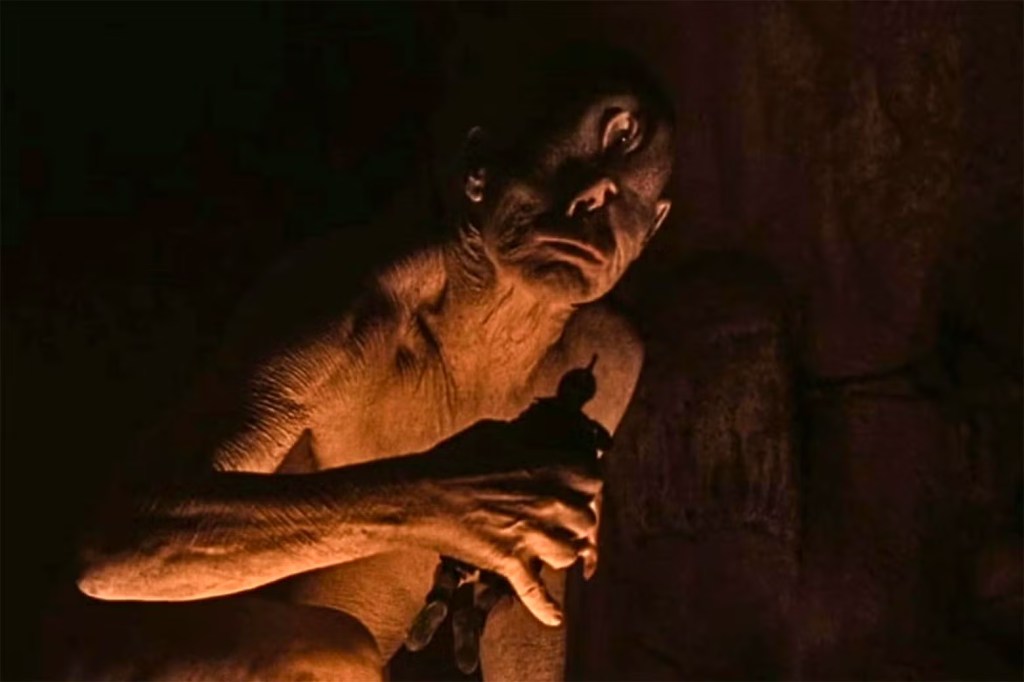
The trickery reminds me of Bert I. Gordon’s 1957 The Cyclops, which superimposed close-up footage of Duncan Parkin wearing facial prosthetics to appear as if there is a giant monster in scenes with the human search crew stuck looking for a lost fiancé in a radioactive jungle that enlarges all species who venture into it. The film is laughably bad today. You can check out the special effects below:
The band of soldiers, stuck in the cave — unable to move the massive boulder Polyphemus has moved to cover the cave entrance with — conspire to attack the Cyclops in his sleep, and stab him in the eye to blind him.
There is an added layer of horror after Odysseus’ crew wounds the Cyclops when it crouches in a corner and speaks with great sadness — the soldiers even remarking with shock that it is capable of talking. It feels like a small moment of Nolan asking the audience — what makes a monster a monster? What makes a monster human? What happens when we are more ready to view the obscure and absurd as inhuman and monstrous than as sentient beings worthy of respect?
When Odysseus and his party cross the line into the cave, unknowingly daring to treat Polyphemus’ flock of sheep as meat to slay and feast on, they are encroaching on the territory of something they forget to treat with xenia — or Zeus’ law. Each island the soldiers visit similarly offers monsters — easier to treat as beasts to slay than the innocent Trojan villagers the Achaean soldiers murdered at Troy: a memory that plagues Odysseus’ conscience, with us learning at the conclusion of the film that the physical representation Athena that haunts Odysseus throughout the film was Odysseus’ guilty projection of a villager woman beheaded in the Temple of Athena.
The soldiers escape the cave by blending in with the sheep — using hay to mimic wool instead of tying themselves to the belly of the sheep like in the myth. Polyphemus catches on that they are leaving and thus begins one of the film’s many chase sequences — a feature of action and horror alike. As they reach the boats, which Odysseus orders to begin departing, we already know in the audience it will be impossible to save everyone scurrying towards the waves. The safety of the water is an illusion — which we learn as Polyphemus dips himself into the ocean, descending beneath the water as the Greeks swim towards the boats. There’s a silence for a moment as the audience braces for impact when Polyphemus bursts up from the waters, soldiers in hand. It’s another moment of Nolan using blindness to build atmospheric dread and rattle his audience. Rather than the darkness of the cave, it’s the murkiness of the water where we wonder — like in Jaws and The Creature from the Black Lagoon — not just what lies underneath but when it is going to strike.
That’s not where the horror elements in the movie end, though. When the soldiers arrive hungry at Lamos, they stumble across an armored man in a forest. Nolan places much emphasis in the film on the violent visual rhetoric of an army, regardless of that army’s intentions. Odysseus commands his army to approach benevolently, but in battle armor and wielding weapons, anyone would treat such an approaching crowd with fear and defensiveness.
As the man turns around to face them — something isn’t right. He has the facial appearance of a child, but his body is easily bigger than even the tallest Achaean, and in the face of the army he laughs at them. Eurylochus speaks to him in a raised, entitled tone, to which Odysseus defends the stranger for only being a child. Then the realization settles in: if this is the size of a child, what could its parents possibly look like?
The soldiers realize what happens next cannot be good. The child opens his mouth and screams, summoning at will hundreds of armored giants ready to slay the army.

It is not the massive giants — the Laestrygonians — that make the next chase sequence of the movie a nail-biter, but the movement of the trees which trap soldiers in like pigs (more on that later — its a major emphasis of the film) to be killed by the armored giants. The horror of the scene is tied to the inability of physical strength to save the soldiers. Even the fastest of runners can find themselves cornered and trapped between the moving trees. It could then be argued physical strength is the weakness of the soldiers within the magical forest — bulk and armor prevent the Achaeans from sliding through the gaps of the trees. This entire scene is an adaptive choice by Nolan. In the myth, there is no forest but instead a city called Telepylos where Odysseus army is met by the cannibalistic Laestrygonians. Similarly to the Cyclops, the giants are portrayed by real 7-foot-tall stunt actors to add realism to the otherwise mythical scene.
The most creative horror-infused segment of the film that even made my friend squeamish comes when the soldiers come to the island of Aeaea. The tensions are high — frustration churning within the dwindling army coming to distrust Odysseus’ leadership. Odysseus parts from his soldiers — going off to hunt while the remaining soldiers, led by Eurylochus, approach a shack at the top of a hill in search for food.
Armored and wielding weapons, the soldiers startle the shack’s owner Circe who expects their arrival to mark her rape, robbery, and murder. Eurylochus insists they are only hungry and not there to harm her, and when she allows them in her home after insisting they leave their weaponry outside, their bulky physique still fills the crowded shack. Their hands and boots are all over everything she owns, their boisterousness becoming the overt focus of the scene. When they sit down to feast, their messiness and lack of care take up the entire screen — with claustrophobic shots of their open mouths shoveling down food that seems to snake down their throats like vines without ever stopping to take a breath. They seem transfixed, unable to stop eating as the volume cranks on their sloppy chewing and slurping noises, prompting emotions of disgust from the audience.

It’s clear from shots of Circe’s darting eyes and cryptic manner of speech that she is up to something. Even those aware of the myth cannot be prepared for the way in which Circe transforms the soldiers into pigs. She wraps her arms around the head of the first soldier — still chewing — and begins to grab at his face. It moves with her touch. She goes around to each soldier as slurping and sloshing make up the soundtrack of the scene, squishing their cheeks and twisting their noses — pressing jawbones between her hands as she forms everyone at the table into pigs.
At the same time, Odysseus is out hunting in a field — giving a deer a fighting chance to escape by pulling the string of his bow to send the animal into a sprint. His supreme hunting skills land an arrow into the deer, who falls out of view, but when Odysseus approaches, his arrow is in buried in the back of a naked man, and he realizes his soldiers are in trouble.
The script carves out dialogue to emphasize the immorality of Odysseus’ army once Odysseus confronts Circe. Odysseus grapples throughout the film with the actions of the Achaeans at Troy, with a scene late in the film where Odysseus confesses to his wife Penelope that he and Agamemnon’s soldiers raped, pillaged, and murdered innocent Trojans. The army’s version of strength is rooted in violence, and regardless if Odysseus views his soldiers as the good guys, cognitive dissonance chases him throughout the film — both in the form of mental torment and in the imaginative form of Athena/the Trojan villager. Circe makes this connection obvious — turning his crew into literal pigs to represent their animalistic and base way of behaving — careless to what a lone woman or child or Cyclops would think of armed soldiers approaching them.
The horror elements in this film utilize the fear of the individual to turn it back onto the soldiers and thereby the audience placed in the midst of the army like they too are in battle with them. Each scene taut with horror tropes and tactics involves an individual who is subject to the whims of Odysseus’ soldiers. While the Achaean army must fight every battle and challenge offered their way by those they encroach upon, Circe makes it clear that the opposition is not evil for fighting back — and villains can change depending on who is narrating the story.
Christopher Nolan effectively uses horror segments to, layer by layer, display the horror of the Achaean army. Penelope fears for Ithaca’s fate early in the film — beyond the intentions of her many suitors who conspire behind the scenes to murder her son Telemachus — and speaks of the threat of pillaging seafarers she heard of that were ravaging every port they stopped at. As Odysseus shares tales of his journey at sea, Penelope comes to realize the seafarers she feared was her husband’s own crew.
While the film harps on about Zeus’ law, the more present theme of the film in my opinion, regards atonement and Odysseus’ internal moral journey of reflection and guilt for his contribution to the murder of the Trojans and choices that resulted in the death of his soldiers. He confronts his deceased army at Hades, with Sinon representing all those who met death by following Odysseus. Some people ponder whether this is an actual event or if it is merely a representation of Odysseus’ guilt (gotta love Nolan’s ambiguity), but Odysseus learns during this scene from the prophet Tiresias that he is doomed to be the sole survivor of his crew, and after witnessing so much death of their fellow soldiers, his crew will come to distrust Odysseus, and this will be what causes their deaths. Survivor’s guilt acts then as a punishment Odysseus must surrender to on the island of Ogygia as he chooses to remember his the pain of his past and leave the safety of Calypso’s care to return to Ithaca and save his wife and son.
In reunion with his wife under the guise of a beggar, Odysseus confesses his actions as Athena weeps next to him. Athena’s position as being both a God and the physical form of a Trojan villager allows Odysseus’ atonement to be both spiritual and human. It is an apology to the Gods for violating Zeus’ law through his continued abuses and an apology to the people he irreparably harmed along the way. The confession is a necessary release of the film to allow the final battle to ensue, with Odysseus taking on Antinous and all of Penelope’s suitors in one last action-packed scene.
While horror was never necessary for the film to communicate the same message, the choice to imbue the film with touches of the genre was a way of acknowledging the terror of reality — of being belly-up at the blade of an Achaean, entirely subject to their mercy or violence. For all of the magic of the myth, the film grounds itself as much as possible in reality. We see no Gods, and even creatures like the Cyclops and the Laestrygonians are more human than they are fantastical.
It is the people who are the real horror, this film argues. And they must face that truth just as much as those subject to their blade. Nolan’s The Odyssey concludes, leaving its audience with the resounding question: is there really such thing as a hero when he must become a villain to so many along the way to his victory?
 S.L. Kletz
Leave a comment